Soya Chunks Machine Manufacturers
Soya chunks, often sold as meal maker, are made on an extruder that cooks defatted soya flour and shapes it into chewy, protein-rich pieces. SN Engineering Works, based in Noida, Uttar Pradesh, builds these machines and has been making food processing equipment since 2012.
We size each machine to the chunk you want to sell and the output you need, and our team handles installation and operator training.
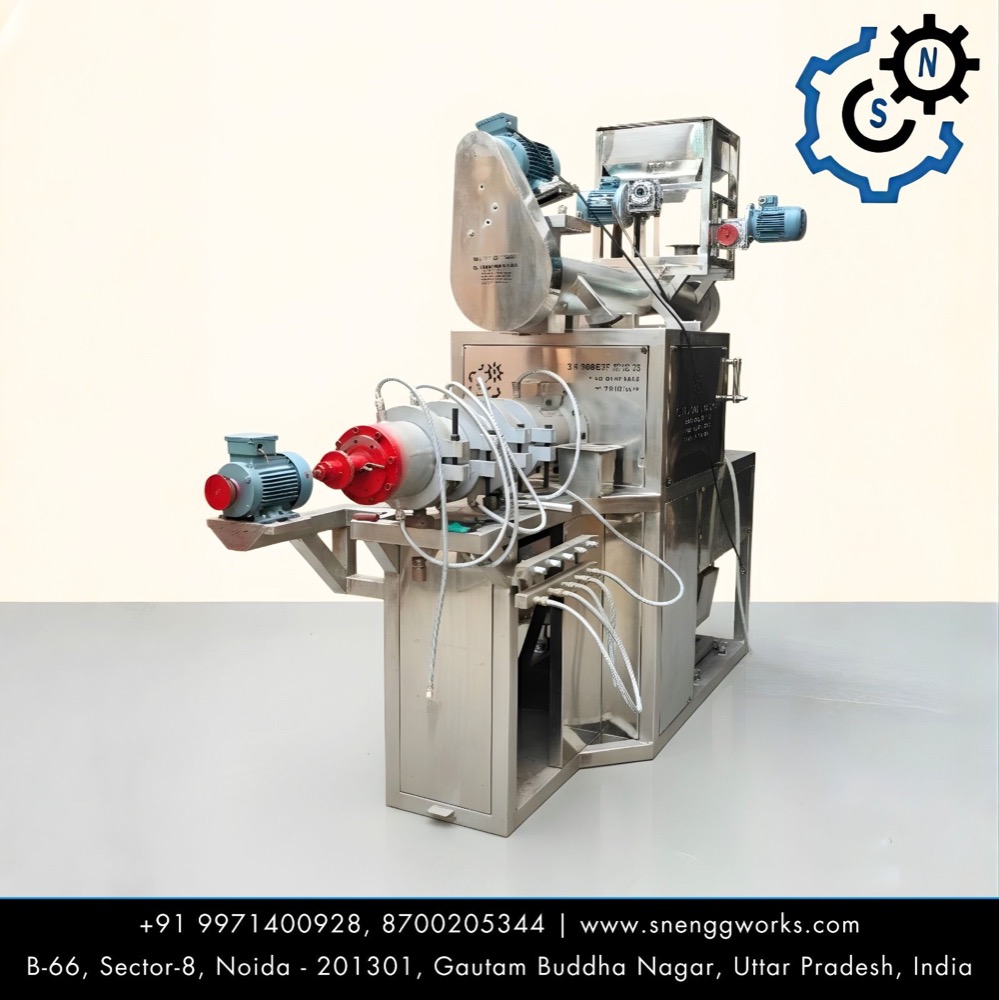
Soya Chunks Machine
Approx. Price: Rs 8 Lakh / PieceProduct Details
| Parameter | Specification |
|---|---|
| Snacks Type | Soya Nugget |
| Usage / Application | Industrial |
| Automation Grade | Automatic |
| Country of Origin | Made in India |
How Soya Chunks Are Made, Step by Step
A soya chunks machine does more than shape the product. It cooks, expands and cuts it in one continuous pass. The usual stages are:
- Feeding: defatted soya flour is loaded into the hopper and metered into the barrel.
- Cooking: a screw carries the flour and water forward, heating and pressing it into a dense mass.
- Die: the mass is forced through the die. As pressure drops, it expands into a porous, fibrous texture.
- Cutting: a cutter at the die face trims the chunks to length.
- Drying and cooling: moisture is removed so the chunks stay firm and keep well.
- Packing: finished chunks are packed for sale.
Our soya chunks plant page shows how these stages fit together on a full line.
What Decides the Quality of the Chunks
Buyers judge soya chunks by how they look and how they behave in the kitchen. They should hold their shape, take up water evenly and stay chewy rather than turning mushy.
Four things drive that result: the soya flour you start with, the cooking conditions in the barrel, the condition of the die and cutter, and how well the chunks are dried. A manufacturer who talks about all four, and not only the motor size, understands the process.
Common Chunk Problems and Likely Causes
If you already run a machine, these are the problems we are asked about most often.
| Problem | What it often points to |
|---|---|
| Chunks crumble or break | Low moisture during cooking, or worn die and cutter parts. |
| Chunks feel too hard | Too much cooking heat or pressure, or over-drying. |
| Uneven chunk size | An unsteady feed, or cutter speed that does not match the extruder output. |
| Dark or patchy colour | Excess temperature or uneven heating in the barrel. |
| Soft or sticky pieces | Not enough drying time before packing. |
Choosing a Soya Chunks Machine Manufacturer
Before you place an order, it is worth getting clear answers to these questions:
- Which chunk sizes can the machine make, and can new dies be added later?
- What output do you get with your own soya flour, not only the rated figure?
- Are food-contact parts in stainless steel, and how easy are they to clean?
- Which dryer suits this extruder? See our notes on soya chunks drying.
- Who provides installation, training and spare parts after delivery?
Who Buys a Soya Chunks Machine
Our customers are usually first-time entrepreneurs planning a soya chunks brand, food companies adding a plant-protein line, and existing processors who want to replace an older machine or add capacity.
Working with SN Engineering Works
We build the machines at our workshop in Sector 8, Noida. Mr. Mohd Naeem guides the company, and customization is part of how we work: you tell us the chunk, the output and the space, and we configure the machine around that. Our team installs it at your site and trains your operators, so production can start with people who know the machine.
Frequently Asked Questions
Both are made by extruding defatted soya flour, so the process is the same. The names usually describe size, and the size comes from the die and cutter settings.
Soya chunks are normally made from defatted soya flour mixed with water inside the extruder. The quality and moisture of the flour affect how the chunks turn out.
Common causes are low moisture during cooking, worn die or cutter parts, an unsteady feed, or a cutter speed that does not match the extruder output. A technician can check these on your machine.
Share the chunk size you want, your hourly output, the soya flour you use, your floor space and power supply, and whether you want the extruder alone or with a dryer.